
For decades, real estate investment across Africa has been perceived as a privilege, reserved for those with deep pockets, insider access, or hundreds of thousands of dollars sitting idle. That belief is no longer true. Like in other parts of the world, Real Estate Investment Trusts (REITs) are providing a more affordable platform for investment across the continent’s real estate markets. Today, REITs have emerged as an equalizer, allowing individual investors to own stakes in institutional-grade real estate assets, alongside pension funds and billionaires, without buying land, managing property, or tying up millions in capital. In this article, we break down how REITs work, examine the African REIT landscape, profile existing operators/compare historic return performance across the continent, and show clearly how Africans can participate intelligently.
.avif)
But before we dive in, what are REITs really?
The "Mutual Fund" of Real Estate
A Real Estate Investment Trust (REIT) is a financial instrument that allows investors to own a piece of income-producing real estate, functioning as mutual funds for property. Like mutual funds, REITs offer liquidity, diversification and income through dividends. REIT operators on the other hand, are companies licensed to own, operate, develop or finance income-producing real estate trust assets. Think of it as a mutual fund for property. Instead of needing $300,000 to buy investment property in Upper Hill, Westland Area, Bantry Bay or Ikoyi, you can buy units of a REIT for as little as $10 or less.
REITs pool capital from thousands of investors to acquire/build high-value assets like shopping malls, student hostels, office complexes, and luxury apartments. The income generated through these instruments are then distributed to investors. The modalities, however, depend on jurisdiction. For instance, in South Africa, there is legislation obligating fund managers to pay out at least 75% of their taxable earnings but in Nigeria, the figure is higher as REITs distribute at least 90% to 95% to shareholders as dividends, making them a consistent source of passive income. REITs commonly enjoy tax exemptions in Africa like standard Company income tax (CIT), VAT, and Capital Gains Tax (CGT) on property income provided they meet mandatory redistribution of dividends.
Now that we have examined what REITs are, let’s look at the African market.
The African REIT Landscape: Players and Managers
The real estate investment trust market in the continent is vibrant with varying levels of regulatory maturity and specialized fund managers. We take a deep dive into Africa’s prominent players from South Africa, Nigeria, Kenya and Morocco to understand the market.
Sophisticated South Africa.
South Africa boasts the most mature REIT market on the continent, accounting for over 95% of the continent’s REIT value, with a market cap of around $29 Billion. The sector has undergone a massive re-rating in 2024 and 2025, recently delivering a staggering 46.2% year-to-date total return by late 2025, outperforming developed markets like the US, UK and even the Global REIT Index at 12% increase. As of today, there are over 30 REITs listed on the Johannesburg stock exchange (JSE) that are diversified with funds in residential, logistics, industrial, office and retail real estate assets. Two key players in the South Africa Market are;
Growthpoint Properties (GRT): This is the largest primary-listed REIT, self-managed and highly diversified. The fund covers a diversified portfolio of over 450 retail, office, and industrial properties both locally and internationally. It has an estimated market capitalization of $3.75 billion and dividend yield was 7.15% as at the end of 2025.
Redefine Properties (RDF): is known for its high-quality office and retail assets (prominent mention being the Centurion Mall in Gauteng, South Africa). It has been aggressive in recycling capital by selling non-core assets to reinvest in high-growth logistics and industrial spaces. It also offers diversification with retail, self storage, logistics, industrial and office assets in both South Africa and Poland. Redfine has a market capitalization of over $2.6 Billion, sells at $0.37 per share and a yield of 7.38%.
Innovative Kenya.
Kenya's market is made up of I-REIT (Income) and D-REIT (Development) structures that are world-class in their design, particularly in the student housing niche. While the Kenyan market is relatively new, it has pioneered the introduction of unique products like the proposed first dollar-denominated I-REIT, which aims to mitigate currency risk for international investors. The key players are;
Acorn Student Accommodation REIT: is a successful niche D-REIT that focused on student housing and development making it one of Kenyan revolutionary players. It is managed by Acorn Investment who grew the Net Operating Income (NOI) by over 117% in H1 2025 outperforming several generalist funds.
LAPTRUST Imara I-REIT: This is a pension-fund-backed I-REIT managed by County Pension Fund (CPF) Financial Services. It provides a stable, pension-backed vehicle for diversified property exposure holding commercial, retail, and residential assets. This Income REIT is an institutional-grade vehicle for Kenyan retirees and public investors. It is an easy entry and suitable for a long term investment.
Morocco: The Attractive Outlier
Morocco is currently the "bright spot" of African real estate, ranking at the top of the Attractiveness Index. With a stable currency that even saw slight appreciation recently and construction costs as low as $600/sqm (well below the continental average of $1,188/sqm), it is a prime destination for REIT capital. Major players in Morocco Retail real estate assets have recorded strong occupancy rates as the middle class expands and tourism remains vibrant.
Immorente Invest: The pioneer of the Moroccan REITs (Organisme de Placement Collectif Immobilier (OPCI) market with a market cap of approximately $90M. It is highly "popular" for its focus on acquiring and developing professional rental properties, like offices, logistics centers, and factories, to generate recurring income for shareholders, targeting high-quality assets with solvent tenants in strategic locations in Morocco, such as Casablanca and industrial zones.
Nigeria: Growth and Value play.
Before now, Nigeria’s REITs market was controlled by three major players listed on the Nigeria Exchange (NGX). Recently, the Ministry of Finance (MOFI) entered the REIT landscape by incorporating (MOFI) Series 2 Real Estate Investment Fund on November 11th, 2025.
By listing 1 billion units at $0.07 each, the Nigerian government injected millions of dollars in liquidity into the sector, signaling a bullish 2026 in Nigeria. The MOFI is designed to provide mortgage liquidity and drive up the value of all other residential REITs. Nigeria’s REIT market is currently dominated by a few major players: SFS REIT, UPDC REIT and the UH REIT.
SFS REIT: Growth Engine
At $0.29, SFS REIT is considered the blue chip of the sector. Its performance in 2025 proved that residential and commercial rentals in prime Lagos locations are inflation-resistant. In 2026, it is expected that SFS will lead the market in capital appreciation as institutional funds rebalance away from falling Treasury Bill yields into high-quality equities.
UPDC REIT: Long Run Value Play
The UPDC REIT, currently sold at > $0.01, is arguably the most undervalued asset on the NGX relative to its Net Asset Value (NAV). For students and young professionals, this is the entry door. Its massive earnings recovery in late 2025 suggests that the management is successfully optimizing its Grade-A office and retail portfolio.
Historic Performance vs. Alternatives
To determine if REITs are a "Buy," we must look at the hard numbers from the high-interest-rate environment. The African market is currently divided between value plays versus growth plays.
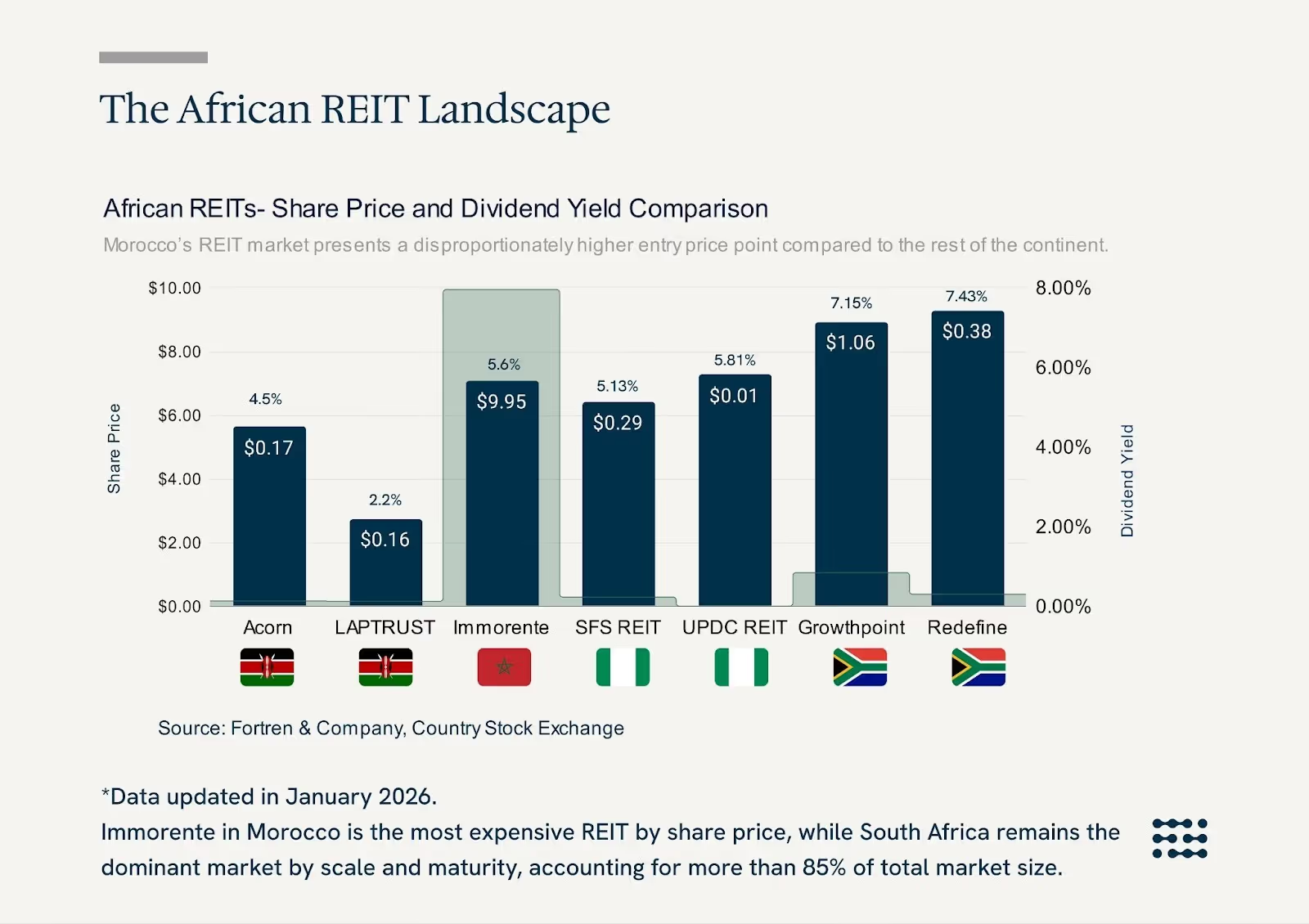
1. Dividend Yield vs. Inflation
In high-inflation environments, a dividend yield in isolation can be misleading. The real goal for African investors is Total Return which is the combination of cash dividends and the underlying growth of property values. This is a tricky situation because as construction costs skyrocket, existing real estate infrastructure becomes more valuable, driving up the Net Asset Value (NAV) of REITs. However,
2. Risk-Adjusted Returns
In Nigeria, REITs provide the lowest risk (volatility) compared to other direct stocks. Compared to Treasury Bills that offer flat but relatively high yields (20-22%), they offer capital appreciation. This allows investors to play for portfolio growth over time. Nigerian real estate assets typically appreciate at 15-20% annually in high-demand urban centers, while in other African countries like Nairobi, Casablanca, and Sandton the number is 10–20% annually. This capital appreciation is captured in the REIT's Net Asset Value (NAV).
Step-by-Step: How to Invest in African REITs
Whether you are a student or an institutional treasurer, the process is now digitized and accessible:
- Open a Brokerage Account: In any of these African countries, you need an account with a licensed stockbroker (e.g., Stanbic in Nigeria, Sterling Capital in Kenya, or EasyEquities in South Africa). You can check for a licensed stockbroker with the Capital market regulatory body like Securities and Exchange Commission (SEC) in Nigeria, CMA for Kenya.
- Get your Investor Identification: Different countries have a form of investor ID that will be provided to you upon opening your brokerage account. You will need this before you can buy stocks or in this case, REITs. In Nigeria, you get a CSCS number, South Africa calls it a CSD Number, while in Morocco it is known as Unique Investor Identifier.
- Fund Your Account: Start with any amount. Many brokers allow mobile app funding via bank transfer. Remember that the REITs are just like mutual funds and the more units you buy, the more you benefit from capital appreciation and dividend yields.
- Research REITs : Check the Net Asset Value (NAV) or the Dividend Yield of the REIT. If it is trading at a discount to its NAV (common in Nigeria and Egypt), you are essentially buying $1.00 worth of property for $0.80. Look for a yield that matches or exceeds the inflation rate. In South Africa, yields of >7% are the gold standard for 2026.
More simply, check the share price changes over a period of time, it will show you if there is a potential for growth which reflects capital appreciation.
- Select Your REIT and place your order: After you have done sufficient research on REITs, you can select your choice and place a buy order. You could decide to take any existing order or place an order at your desired price given the market situation.
- Automate: For young professionals, use Investment platforms like Bamboo, PiggyVest (Investify) or Cowrywise that offer curated real estate pools.
2026 Outlook for The REITs.
The 2026 outlook for African Real Estate Investment Trusts (REITs) is defined by a transition from defensive yield-seeking to strategic growth as regional economies begin to stabilize from the volatility of 2024 and 2025. With major luxury residential and student housing projects slated for completion throughout the year, 2026 will be a pivotal delivery year for the continent's property capital.
Logistics REITs are particularly well positioned for a great year as the beneficiaries of the AfCFTA (African Continental Free Trade Area). Grade-A warehousing is in short supply and Managers who own assets near ports (Durban, Lagos) or air hubs (Nairobi) will see rental escalations that outpace inflation.
Final Decision: Is this your sign to Buy or Sell?
So what is the way forward? While REITs wouldn't make you an overnight millionaire, they could take your $120 in January to over $350 by December 2026 depending on the market you're buying. REITs are the easiest entry into the real estate market and the most liquid way to cash in on the property appreciation happening everyday around us. That is why our final decision is this: 2026 is a BUY for REITs in Africa.
**Note this is not a financial investment template and readers should make their own investment decisions based on their personal financial situation, objectives, and risk tolerance.
If you need a bespoke research on this market or any other asset class across the continent, send an email to our advisory team at advisory@fortrenandcompany.com. We love your feedback. Let us know what you think about the African REIT market by sending an email to team@fortrenandcompany.com. You can also join the conversation here on Linkedin.
%2520(1).avif)